

There is a particular kind of feeling I think most of us know well, it’s called Motivation. It’s the late-night surge of determination where everything suddenly feels possible. You watch a video, read a quote, or hear someone’s success story, and something lights up inside you. You open a notebook and write a plan. You tell yourself, “Starting tomorrow, everything changes.”
Then tomorrow comes. The alarm rings, the bed is warm, the plan looks heavier in daylight, and that fire you felt last night has quietly gone out.
For years I assumed this was a personal flaw. I believed other people simply had more willpower, more drive, more of whatever magic ingredient I was missing. It took me a long time, and a lot of abandoned plans, to understand something that changed how I approach almost everything: motivation was never supposed to carry the weight I was putting on it.
This article is about why motivation fails, why that’s completely normal, and what you can build your life on instead.
The Myth of the Motivated Person
We tend to imagine that productive, successful people wake up every day bursting with energy and desire. We picture them leaping out of bed, eager to work, never struggling with doubt.
The reality, from what I’ve seen in people I know and in my own life, is much less glamorous. Many people who accomplish a lot feel just as lazy, tired, and uncertain as everyone else. The difference is that they don’t wait to feel ready. They have built things around themselves, routines, systems, and expectations, that move them forward even when the feeling isn’t there.
I once knew a man who ran a small shop near where I grew up. He opened it at the same hour every single morning, whether business was good or terrible, whether he was in a great mood or a miserable one. I asked him once if he always felt like going to work. He laughed and said, “Of course not. But the shop doesn’t care how I feel.” It stuck with me. He wasn’t running on motivation. He was running on routine and responsibility, motivation may fail you but pattern is consistency.
Why Motivation Fails

1. Motivation is an emotion, and emotions change
Motivation is a feeling, just like happiness, sadness, or excitement. Feelings rise and fall based on sleep, stress, weather, health, conversations, even what you ate. Expecting yourself to feel motivated every day is like expecting to feel cheerful every day. It’s not realistic, and building your life on it is risky. Feeling can never be consistent so as motivation.
I’ve noticed that my own motivation is highest when I’m planning and lowest when I’m doing. Planning is fun because it’s imaginary. Doing is real, which means it’s uncomfortable, slow, and sometimes boring and exhausting.
2. Motivation peaks at the beginning, when you need it least
Early enthusiasm is easy. The beginning of anything is exciting because it’s new. The real test comes weeks later, when the novelty has faded and progress feels invisible. That’s exactly when motivation tends to disappear, and exactly when you need to keep going.
Think about gym memberships in January versus February. Or a new language app that you used daily for ten days and then forgot about. Most of us have experienced this. It’s not because we’re weak. It’s because the emotional high of starting is temporary by nature.

3. We use Motivation to chase goals that are too big and vague
“I want to get fit.” “I want to be successful.” “I want to save money.” These goals feel inspiring, but they don’t tell you what to do on a Tuesday afternoon at 4 PM. When the goal is huge and unclear, motivation has nothing specific to grab onto, and the gap between where you are and where you want to be can feel crushing.
When I was trying to build a writing habit, my goal was “become a good writer.” That was too big to feel real. Every time I sat down, I felt the distance between my current ability and that imaginary version of myself, and I would close the laptop in frustration.
You won’t remain motivated for ever especially when you don’t get instant results of your efforts, that is the reason your success shouldn’t solely depend on motivation rather routine and responsibility.
4. Perfectionism kills the momentum
Many people lose motivation not because they stopped caring but because they missed a day. One skipped workout turns into “I’ve ruined my progress, so why bother?” This all-or-nothing thinking is a motivation killer. When we believe a single failure erases everything, we quit instead of continuing imperfectly.
If you wish to be perfect to keep going I will be honestly with you, you will be static in life. Who told you success is tied to perfectionism? You must not be perfect before you can succeed, there is a saying “Practice makes Perfect” The word Practice implies you keep going/working regardless of your imperfection, at the process you get better.
Start whatever you need to start today don’t wait till you’re perfect in it, don’t wait till you have all the best gadgets for it. Begin today and see how you improve tomorrow, start today and see how you advance tomorrow. Start first and get better later, you can only get better not perfect. Be careful never to have the mindset of being perfect because it kills growth, the moment you believe you’re perfect you will stop learning and stop improving until you become outdated.
5. We confuse waiting with preparing
Sometimes we say we’re “waiting until we feel motivated,” but what we’re really doing is avoiding discomfort. The feeling we’re waiting for often doesn’t come until after we begin. This is something I wish I had learned ten years earlier: action often creates motivation, not the other way around.
What I Learned From a Season of Doing Nothing
There was a period in my life when I felt completely stuck. I had things I wanted to do, and I kept telling myself I’d start once I felt more inspired. I watched motivational videos for hours. I felt great while watching them, and then nothing changed.
At some point, I realized I had become addicted to the feeling of being about to start. The inspiration was a substitute for action, a comfortable place to hide. Weeks passed. Then months.
What finally broke the cycle wasn’t a burst of motivation. It was a small, almost boring decision. I told myself I would write for just five minutes a day, no matter how I felt. The idea was so small that my brain couldn’t argue with it.
Some days those five minutes were terrible. Some days I wrote a few sentences and closed the laptop. But I showed up. And somewhere in the second or third week, I noticed that I was occasionally writing for twenty minutes without trying. The motivation I’d been waiting for had arrived, but it came after the action, not before.
This is a real life experience and its authentic, it has been verified by many people, the motivation they waited for only arrived after they have started. It might have happened to you same way many times but you paid less attention to you. Don’t wait till you’re in the mood before you can start.
What to Rely On Instead
If motivation is unreliable, what should we build on? Here is what has worked for me and for people around me.
1. Systems and routines
A system is simply a repeatable way of doing something that doesn’t require you to decide every time. Brushing your teeth is a system. You don’t wake up and debate whether you feel motivated to do it. You just do it. Happy or Sad you must brush, emotions doesn’t detect whether you will brush or not system and routines works
Try building small routines around what matters to you. Same time, same place, same trigger. For example, “After I finish breakfast, I sit at my desk and work for twenty minutes.” When the routine is clear, you remove the daily negotiation with yourself, and that negotiation is where most of our energy gets wasted.
Once it becomes a routines, you won’t waste time deliberating if you will do it or not. Your body system has gets programmed to always carry out the task whether happy or sad.

2. Tiny starting steps
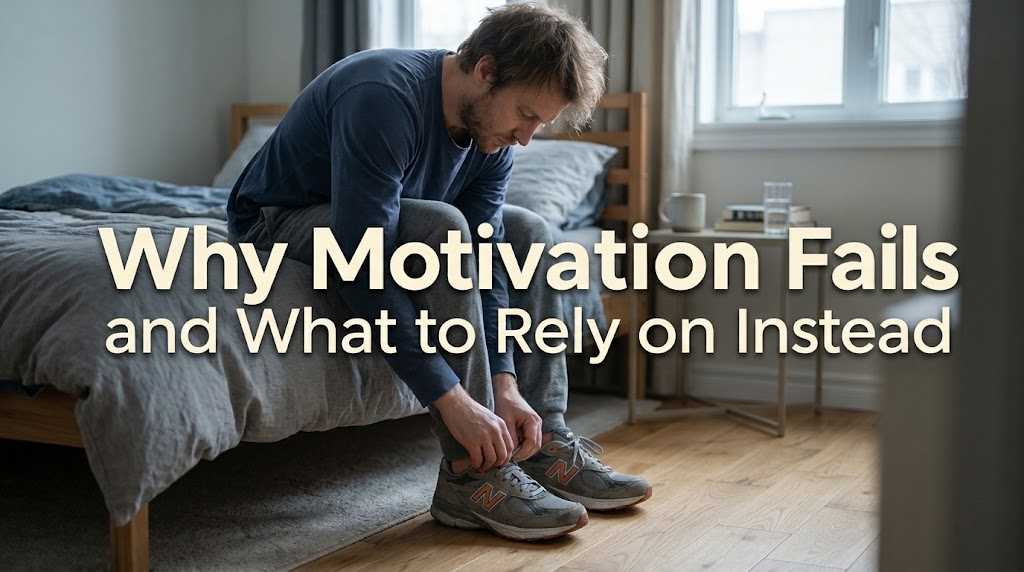
The hardest part of any task is beginning. So make the beginning ridiculously small. Instead of “clean the house,” try “pick up five things.” Instead of “write a chapter,” try “write one paragraph.” Instead of “go for a run,” try “put on my shoes and step outside.”
Starting small removes the resistance. And once you’ve started, continuing is far easier than you expect. If you stop after the tiny step, that’s still a win, because you kept your promise to yourself.
When I started early morning run, people who see me in the street running so early as 5am might actually time I woke up one morning and decided to start the morning street run but the truth is before I went off the street I have been running inside our compound. we have a large compound each morning I would run round the compound a few times, the wasn’t a dedicated time some time 6am, sometime 7am depending on my activity schedules for the day which running wasn’t part of it at the time. some time I even run in the evening.
That was how I started until I felt I wasn’t getting enough out of the compound. running round it became a bit boring so I decided to go off the street, I wouldn’t like to run while the street is busy so I dedicated 5am to the running, that was how early morning running became part of my activities per day, at least 3 times a week.
3. Discipline, but the gentle kind
The word “discipline” sounds harsh, but I think of it differently now. To me, discipline is simply keeping a promise to yourself, even when you don’t feel like it. It’s not about punishing yourself or forcing yourself through misery. It’s about trusting that your future self will thank you.
Discipline is also something that grows with practice. Each time you do what you said you’d do, you strengthen your belief that you’re someone who follows through. That belief becomes a quiet source of power.
4. Identity over outcomes
Instead of focusing only on results, like “I want to lose ten pounds,” try focusing on who you want to become: “I’m someone who takes care of my body.” Small actions then become evidence of that identity.
When I started thinking of myself as “a person who writes” rather than “someone trying to become a writer,” my habits changed. On low-energy days, I didn’t ask, “Do I feel like writing?” I asked, “What would a person who writes do today?” It was a much easier question to answer.
Passion driven is different from being motivationally driven, motivation will push you toward the goal but when the result is not outstanding, when the goal/result is delayed motivation fails and fade away that is why you shouldn’t rely solely on motivation. Motivation is like an energy drink, it’s effect has a limited time in your body and once it’s time is up you’re drained already it feels like it borrow the energy you’re from the future and gave you all to utilize at a given time.
Passion being an intense, emotional love or deep interest in an activity itself will keep you going even when the result is not encouraging, your love for the activity will keep you going.
Your surroundings shape your behavior more than you realize. If you want to read more, leave a book on your pillow. If you want to cut down on mindless scrolling, move your phone to another room while you work. If you want to eat better, keep fruit visible and snacks out of sight.
5. Environment design
Instead of relying on willpower in the moment, set up your space so the good choice is the easy choice. This one idea alone has saved me from countless battles with myself.
This might sound crazy to you but I tell you for sure your environment influences your activities especially when you’re trying to start a new activity.
For instance you just started Coding or Write as a new activity in your life and you had a bed next to your office table. If you can write for a whole 2 hours in an office without a bed, when you’re in an office with a bed you will struggle to write for an hour without going to sleep. As a new activity you just started it will take a great disciple to ignore the presence of bed in that your home office.
So try as much as possible to set up your space in a way it will give you a better and easier choice.
6. Accountability and community
We’re social creatures, and sometimes the strongest motivator isn’t internal at all. A friend who checks in, a study partner, a group that meets regularly, or even telling someone about your goal can keep you going when your own energy runs low.
I’ve noticed that I rarely skip a commitment when someone else is counting on me. That tells me something: I don’t lack the ability, I just need a reason that goes beyond my passing mood.
I remember while I was a teenager, I had this high level of responsibility and accountability tied to my neck. There are things others kids will feel comfortable doing but I dare not try to do them, even when no one is watching it feeling like am being watch and I could hear the voices of some elderly people from my kindred saying to me “I do use you to set examples for my children please do not fail me”, “I do brag with your name, please do not disappoint me” these statement always resounds in my ears each time I am tempted to do some that’s not right.
Accountability played its roles shaping my childhood, it can keep you going even when you don’t feel like.
7. Rest and recovery most times better than motivation
Sometimes what looks like lack of motivation is actually exhaustion. If you’re running on poor sleep, constant stress, and no downtime, no amount of willpower will fix it. Before blaming yourself, ask whether you need rest.
There’s a difference between laziness and burnout, and learning to tell them apart is a kindness you can give yourself. Resting is not the opposite of progress. It’s part of it.
8. A clear “why”
Motivation fades, but meaning lasts longer. If you can connect a task to something that truly matters to you, like your family, your health, your freedom, or your growth, you’ll find reasons to continue even on bad days.
Write your reason down somewhere you can see it. On the days when you don’t feel like it, that reminder can do what a pep talk cannot.
How to Handle the Days You Really Don’t Feel Like It
Even with good systems, there will be days when everything in you says no. Here’s what I do on those days.
Lower the bar, don’t skip the day. If I planned thirty minutes, I do five. If I planned a full workout, I do a short walk. The goal is to protect the habit, not to prove anything.
Use the two-minute rule. Tell yourself you’ll do the task for just two minutes, and you’re allowed to stop afterward. Most of the time, you won’t want to.
Don’t punish yourself for missing a day. Just don’t miss twice. One missed day is a pause. Two starts to become a new pattern.
Be kind in your self-talk. I used to speak to myself in ways I would never speak to a friend. Harsh self-criticism doesn’t create motivation, it creates fear and avoidance. Treating yourself with patience works much better.

A Small Experiment You Can Try This Week
Choose one thing you’ve been putting off. Make it very small, so small it feels almost silly. Attach it to something you already do each day. Do it for seven days, even on the days you don’t feel like it. Keep a simple note of each day you complete it.
At the end of the week, notice what you feel. Not necessarily excitement, but maybe a quiet sense of self-respect. That feeling, I’ve found, is a far more stable foundation than the roller coaster of motivation.
WHAT YOU MUST KNOW ABOUT Motivation
Motivation isn’t bad. It’s a wonderful spark when it arrives, and you should enjoy it and use it. But it’s a visitor, not a resident. If you build your life around it, you’ll spend much of your time waiting.
What lasts is something quieter: routines you can repeat, small steps you can take on any day, an environment that supports you, people who encourage you, and a kind but steady commitment to your own growth.
You don’t need to feel ready. You don’t need to feel inspired. You just need to begin, gently, and keep returning. Over time, you’ll discover that you didn’t need motivation as much as you needed a way of moving forward that didn’t depend on it.
Check out this amazing topic 11 Small Daily Habits That Will Quietly Change Your Life
For house design inspirations visit Jerry House Design