
 English
An amazing single-story modern farmhouse
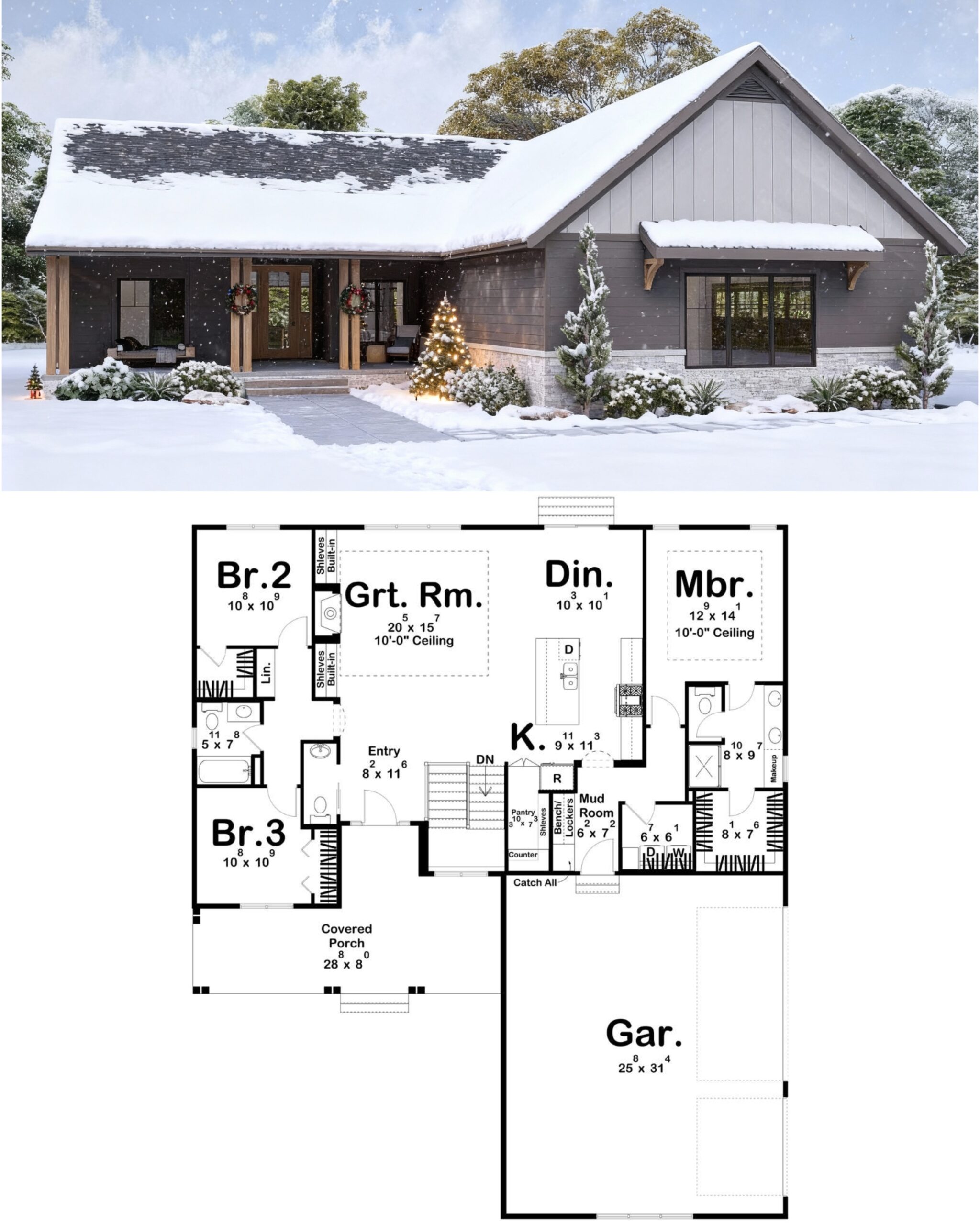
This single-story modern farmhouse floor plan depicts a compact, efficiently designed single-story home that excels in functionality and flow for modern living. Here’s a breakdown of why this layout is appealing and what potential drawbacks to consider
Strengths & Advantages:
- Excellent Zoning and Privacy:
The layout clearly separates the private and public zones. The three bedrooms (Br.2, Br.3, and primary bedroom “Mbr.”) are grouped together, away from the daily hustle. The living areas (Great Room, Dining, Kitchen) flow into one another in a separate wing, perfect for entertaining and family time without disturbing those resting - Open-Concept Living Core:
The Great Room (20′ x 15′), Dining area (10′ x 10′), and Kitchen (11′ x 9′ approx.) form a generous, interconnected space. This is the heart of the home, promoting family interaction, easy entertaining, and a sense of spaciousness, enhanced by the 10-foot ceiling. - Functional and Strategic Kitchen Placement:
- The kitchen is perfectly positioned. It has:
A direct, open connection to the Dining area and Great Room.
A pass-through or serving window to the Covered Porch (28′ x 8′), making outdoor dining and grilling incredibly convenient.
Proximity to both the formal Dining area and the informal “Courier” nook (likely a breakfast area), offering flexible eating spaces.
Easy access to the Mud Room, which acts as a vital drop-zone from the garage/carport.
- The kitchen is perfectly positioned. It has:
- Practical Utility Spaces:
- Mud Room (6′ x 7′):
This is a key feature for organized living. It provides a dedicated space to remove shoes, store coats, and manage groceries before entering the main house, keeping clutter contained. - Large Covered Porch:
Extends the living space outdoors, providing a shaded area for relaxation, dining, or socializing protected from the elements. Its length suggests it runs along a significant portion of the living area. - Linen Closet (Lin.) and Built-in storage (Built-in):
Ample storage is indicated, which is crucial for maintaining a tidy home.
- Mud Room (6′ x 7′):
- Efficient Construction & Modern Features:
Notes like “Silicone” (likely for waterproofing or sealing) and “Mud” (for drywall) point to quality construction techniques.
The 10-foot ceiling in the main living area adds volume, light, and a premium feel.
Disadvantages & Considerations
- Potential Lack of a Defined Primary Suite:
Bedrooms 2 and 3 sharing a hall bathroom. This could be a downside for couples or anyone seeking ensuite privacy. - Room Size Trade-offs:
- While the Great Room is spacious, some bedrooms (e.g., 10′ x 10′) are functionally sized but not large. They comfortably fit a bed and essentials but offer limited space for additional furniture like large desks or sitting areas.
- The Dining area (10′ x 10′) is adequate for a standard table but may feel tight with a large hutch or when entertaining bigger groups.
- Flow-through Traffic in Living Area:
- The central corridor from the bedroom wing leads directly into the Great Room/Dining area. This means foot traffic to the kitchen, porch, or bedrooms will naturally cut through the main living space, which can be disruptive during gatherings or movie nights.
- The central corridor from the bedroom wing leads directly into the Great Room/Dining area. This means foot traffic to the kitchen, porch, or bedrooms will naturally cut through the main living space, which can be disruptive during gatherings or movie nights.
- Formal Entry & “Wasted” Space:
The Foyer (“F”) appears minimal. There is no grand entrance or a dedicated closet immediately visible at the front door, which some may find lacking.
The “Courier” area (8′ x 9′) is an interesting flex space but could be seen as a slightly awkward corridor if not furnished purposefully as a breakfast nook or reading area.
Final Verdict
This is an exceptionally well-planned home for a small family, couple, or empty-nesters who value efficient use of space, strong indoor-outdoor connection, and practical daily living. Its strengths are modern flow, excellent common areas, and smart features like the mudroom and large porch.
The main considerations are the potential bathroom count and the size of the secondary bedrooms. Prospective residents should confirm the bathroom situation and ensure the bedroom sizes meet their long-term needs. If the bathroom layout can be optimized, this floor plan offers outstanding livability in a compact footprint.
Estimated Cost Breakdown for This ~1,600-1,800 sq ft House
Assumptions: The house is roughly 1,600-1,800 square feet (including the covered porch as unfinished space). We’ll assume a full basement is included (standard in much of NY).
We’ll use a common industry metric: Cost Per Square Foot (PSF).
Scenario 1: Upstate / Rural New York
- Land Cost: $50,000 – $150,000+
- Construction Cost PSF: $180 – $280
- Total Build Cost (structure only): 1,800 sq ft x $180-$280 = $324,000 – $504,000
- Total Project Cost (land + construction): $375,000 – $650,000+
Scenario 2: Suburban New York (e.g., Westchester, Long Island suburbs)
- Land Cost: $200,000 – $500,000+ (often much higher)
- Construction Cost PSF: $250 – $400+
- Total Build Cost: 1,800 sq ft x $250-$400 = $450,000 – $720,000
- Total Project Cost: $650,000 – $1.2 Million+
Scenario 3: High-Cost / Custom Build Anywhere
- Land Cost: Highly variable.
- Construction Cost PSF: $350 – $500+
- Total Build Cost: 1,800 sq ft x $350-$500 = $630,000 – $900,000+
- Total Project Cost: $800,000 – $1.5 Million+
Major Cost Components for Your Budget:
- Design & Permits (10-15%): Architect/designer, engineering (structural, septic), and town permit fees (which can be very high in NY).
- Site Work & Foundation (15-20%): Excavation, foundation walls for basement, backfill, drainage.
- Framing & Roofing (15-20%): Lumber (a major cost variable), sheathing, trusses, roofing materials.
- Exterior Finishes (10-15%): Windows, doors, siding, brick/stone veneer, gutters.
- Major Systems (15-20%):
- Plumbing: Especially costly if connecting to municipal vs. septic.
- HVAC: Forced-air furnace/AC or heat pumps. Geothermal would be a premium.
- Electrical: Including service panel, wiring, lighting.
- Interior Finishes (20-30%): This is where your choices explode the budget: drywall, flooring, cabinets, countertops, trim, paint, and fixtures.
- Contingency Fund (10-15%): NON-NEGOTIABLE. Unforeseen issues (rock excavation, weather delays, material price hikes) are guaranteed.
Actionable Steps to Get a Real Quote:
- Finalize Detailed Plans: The text description is not enough. You need full architectural blueprints with structural, electrical, and plumbing plans.
- Select a Specific Parcel of Land: Costs are meaningless without a lot. You must know the topography, soil conditions, and utility access.
- Get Multiple Bids from Local Contractors: In New York, always work with builders familiar with local codes (NY State Building Code, plus local amendments) and weather conditions (insulation, heating requirements). A “General Contractor” will manage all sub-contractors.
- Secure Financing: For new construction, you’ll typically need a construction-to-permanent loan, which is more complex than a standard mortgage.
Bottom Line: For a complete project of this size in New York, a realistic starting point for construction costs only is $300,000 on the very low end in a rural area with basic finishes, and easily $700,000+ in a suburb or with mid-range finishes. With land, the total can range from ~$400,000 to well over $1 million.
Strong Recommendation: Partner with a local architect and real estate agent who specialize in new construction in your target county. They will provide the most accurate localized cost guidance.
Our Facebook fans Feedback and Reviews
Our fans feedback on this layout, you can be part of our Facebook community. Get an insight into their experiences.

I like this layout. Having an owners entrance is very desirable for me. I like the functionality of it. The only thing I’d like to see added is having the laundry and closet accessible to each other. Or maybe flip flopping the bathroom and closet to have the laundry and bathroom as one room. Either way would be fine.

Douglas Schleiss
Facebook Fan
Little wider please, bedrooms are small, coat closet in foyer, garage can be a bit wider also. Fit 2 full size vehicles and fishing boat 🥰

LeAnn Utke
Facebook Fan
No need for that half bath with another bathroom so close. Use the space to make the bedroom bigger and add a coat closet to the entry.

Vickie Sigmund-Hiemstra
Facebook Fan