

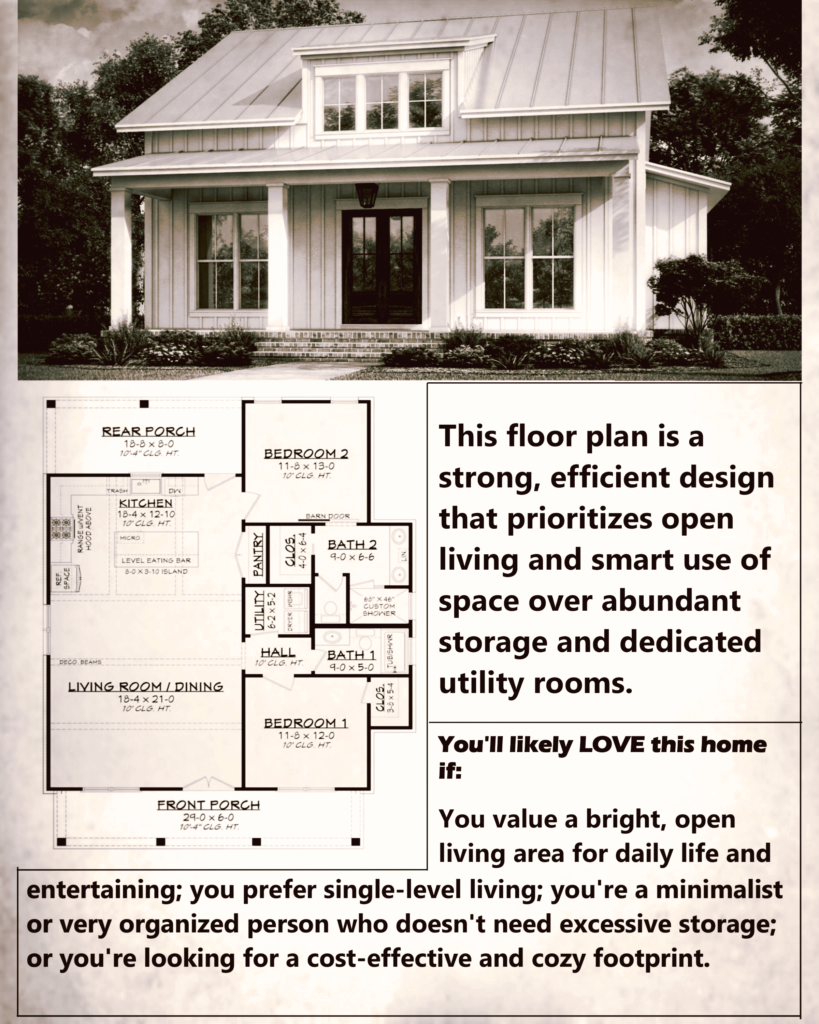
Whether you’re considering building, buying, or simply dreaming about your next home, understanding a floor plan’s strengths and weaknesses is key. Today, we’re breaking down a cozy Single-Story Farmhouse, efficient layout to see if it could be your perfect match.
Let’s dive into the details of this well-organized Single-Story Farmhouse.
What Makes This Layout Work: The Advantages
1. Open & Airy Main Living Zone
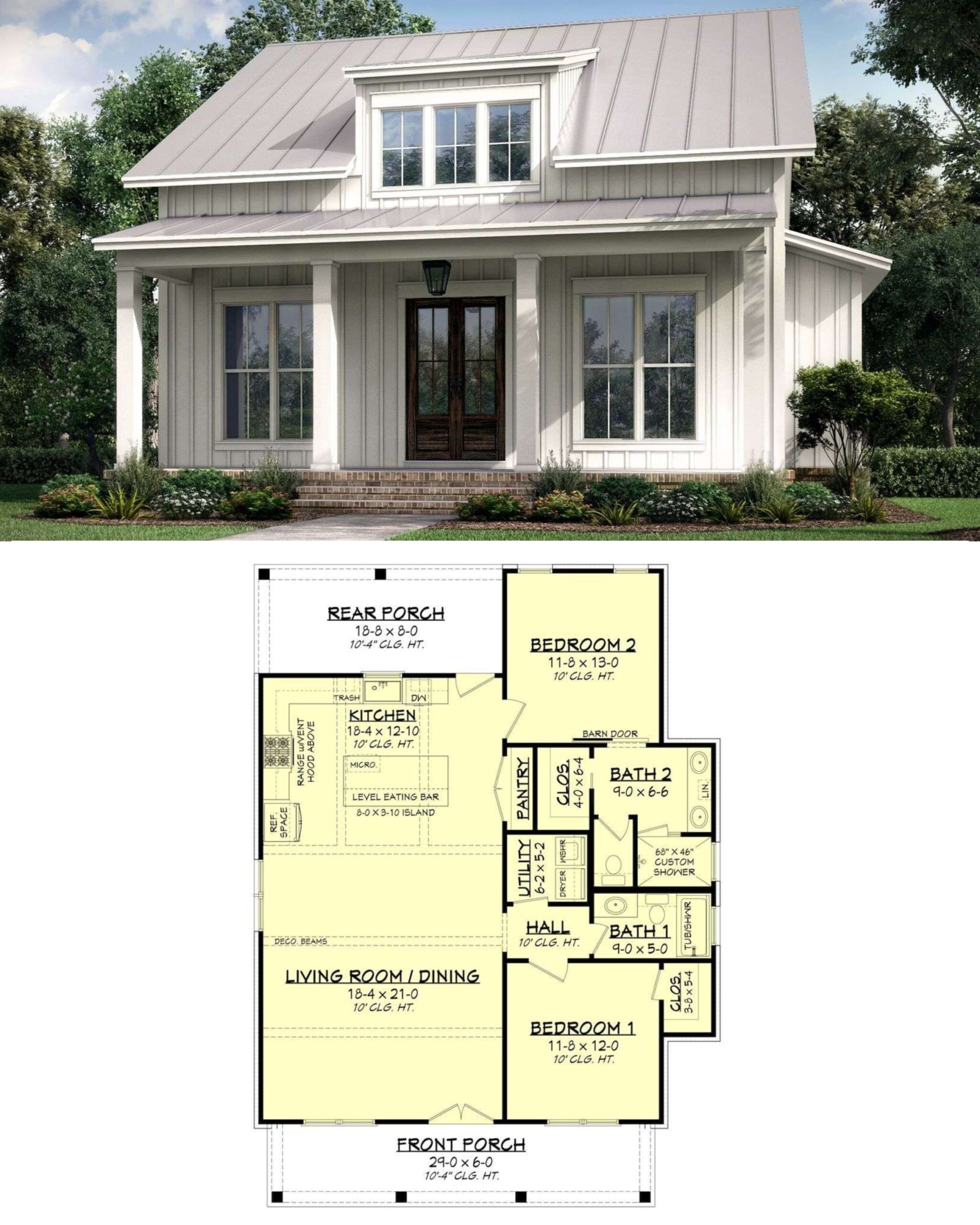
The heart of this home is the generous 18’4″ x 21’0″ combined Living/Dining room. This open-concept space:
-
Creates a fantastic area for entertaining, allowing conversation and activity to flow seamlessly.
-
Makes the home feel larger than its square footage suggests.
-
Receives natural light from two sides (assuming the front and back have windows), brightening the core living area.
2. Smart Kitchen Integration
The kitchen is cleverly designed for modern living:
-
It features an 8’0″ x 3’10” island that doubles as a quick-eating bar, perfect for breakfast, homework, or chatting while cooking.
-
It opens directly into the living/dining area, allowing the cook to remain part of the action—a must for families and hosts.
-
The proximity to the Rear Porch (just a step away) makes indoor/outdoor dining and summer barbecues incredibly easy.
3. Practical Room Proportions & High Ceilings
-
No Wasted Hallways: Space is used efficiently. The hallway is minimal, dedicating more square footage to actual rooms.
-
Bedrooms are well-sized: Bedroom 2 (11’8″ x 13’0″) is actually slightly larger than Bedroom 1, offering flexibility. Both can comfortably fit a bed, dressers, and nightstands.
-
Ceiling Height Bonus: With 10-foot ceilings throughout most of the house (and even 10’4″ on the porches), the home feels spacious, airy, and less boxed-in—a premium feature in any home.
4. Clear & Functional Zoning
The layout follows a classic and successful zoning pattern:
-
Public Zone (Front): Living, Dining, Kitchen.
-
Private Zone (Back): All three bedrooms and the bathrooms are grouped together, separated from the living areas for privacy and quiet.
-
Transitional Spaces: Both the covered Front Porch (29’0″ long!) and Rear Porch provide valuable “outdoor rooms” for relaxing or greeting guests, enhancing curb appeal and livability.
5. Ideal for Specific Lifestyles
This plan is a winner for:
-
Small Families or Couples: With two bedrooms, there’s room for a couple and children or a home office/guest room.
-
Empty Nesters: Single-level living is accessible and low-maintenance.
-
First-Time Homebuyers: It’s an efficient, no-fuss layout that’s affordable to build, heat, and cool.
Potential Drawbacks & Considerations
No floor plan is perfect for everyone. Here are the challenges to consider:
1. Limited Storage Solutions
This is the most significant potential issue.
-
There are no indicated closets in the hallway, bedrooms, or living areas. While likely included in final builds, the lack of notation suggests storage might be minimal.
-
No pantry is shown in the kitchen. The island provides some cabinet space, but a dedicated pantry for groceries is a major convenience many desire.
-
Question: Where do you put the vacuum, linens, coats, or holiday decorations?
2. Bathroom Layout & Count
-
Only One Full Bathroom: Bath 2 is the only bathroom shown. For a 3-bedroom home, sharing one bathroom among multiple people can create morning and evening bottlenecks.
-
Bathroom Placement: The single bathroom is accessed via the hallway, requiring guests to walk past bedroom doors. A layout with a bathroom directly accessible from the main hall is often preferred for privacy.
3. Traffic Flow Friction Points
-
The hallway entrance to the bedroom wing is directly opposite the kitchen sink/area. This could lead to congestion if someone is working in the kitchen while others are moving to/from bedrooms.
-
The island must be carefully designed to allow enough clearance for walking past it while the dishwasher or oven doors are open.
4. Lack of Dedicated Spaces
-
No Formal Entry/Foyer: You step directly from the Front Porch into the Living Room. There’s no transitional space to drop shoes, bags, or coats.
-
No Laundry Room: The location for a washer and dryer isn’t specified. It would likely need to be in a bedroom closet, a hallway niche, or the garage (if attached), which can be noisy and inconvenient.
-
Dining is “Floating”: The dining area isn’t a defined room. While open, it requires intentional furniture placement to feel like a separate zone.
Final Verdict: Who Should Call This Single-Story Farmhouse A Home?
This floor plan is a strong, efficient design that prioritizes open living and smart use of space over abundant storage and dedicated utility rooms.
✅ You’ll likely LOVE this home if: You value a bright, open living area for daily life and entertaining; you prefer single-level living; you’re a minimalist or very organized person who doesn’t need excessive storage; or you’re looking for a cost-effective and cozy footprint.
❌ You might find it CHALLENGING if: You have a growing family that needs multiple bathrooms; you own a lot of “stuff” and require ample closet and storage space; you strongly desire dedicated rooms for laundry, mudroom, and dining; or you work from home and need a quiet, separate office (Bedroom 3 would have to serve this purpose).
The Bottom Line: This is a thoughtfully designed, charming home for the right person. Its success would hinge on clever built-in storage solutions during construction and an occupant whose lifestyle aligns with its streamlined, open-concept philosophy.
Love the flow but need more closet space? This plan is an excellent foundation that can be customized. Consider extending the hallway for a linen closet, reconfiguring the kitchen for a pantry, or designating one bedroom as a combo office/storage room.
Found this breakdown helpful?
Share it with someone considering a new home build or exploring floor plans! Explore more of our detailed home layout analyses at JERRY HOUSE DESIGN.
Did you miss this post?
Floor Plan Review: Amazing Best Modern Rustic Farmhouse layout
Estimated Cost to Build This House in Washington, D.C.
Building a home in Washington, D.C., is one of the most expensive construction projects in the United States due to high land, labor, material, and permit costs. Below is a detailed breakdown for the 1,500–1,600 sq ft single-level home based on the floor plan provided.
🏗️ Quick Summary: Estimated Total Cost
| Cost Tier | Price Range | Description |
|---|---|---|
| Low-End | $600,000 – $750,000 | Basic finishes, smaller builder, possible outskirts location. |
| Mid-Range | $750,000 – $1,000,000 | Standard finishes, reputable builder, central D.C. lot. |
| High-End | $1,000,000 – $1,500,000+ | Custom finishes, premium materials, high-cost neighborhood. |
Note: This does not include land costs, which can add $300,000 – $1,000,000+ depending on location in D.C.
📐 Cost Breakdown Per Square Foot
In D.C., construction costs per square foot are exceptionally high:
-
Average Construction Cost: $400 – $700 per sq ft for a single-family home.
-
This Home’s Size: ~1,550 sq ft (estimated from plan).
-
Construction Cost Only:
= 1,550 sq ft × $400–$700
= $620,000 – $1,085,000
🔍 Detailed Cost Factors
1. Land Acquisition (Lot Price)
-
D.C. Neighborhoods Vary Widely:
-
Northeast/Southeast (less central): $300,000 – $600,000
-
Northwest/Georgetown: $800,000 – $2,000,000+
-
-
Lot Size & Zoning: This plan requires a lot at least 60′ wide × 50′ deep.
2. Soft Costs (25–30% of Construction)
-
Architect & Design Fees: $20,000 – $50,000
-
Permits & Impact Fees (D.C. is strict): $30,000 – $70,000
-
Utility Hookups & Inspections: $15,000 – $40,000
-
Builder’s Overhead & Profit: 15–20%
3. Material & Labor Costs (D.C. Premium)
-
Labor: Union and skilled labor rates are 20–40% higher than national average.
-
Materials: High-quality finishes (hardwood, quartz, custom cabinetry) add $50–200/sq ft.
-
Site Work: Rowhouse tear-down or tight urban lot excavation increases cost.
4. Specifics from This Floor Plan
-
High Ceilings (10 ft): Increase wall height, material use, and HVAC requirements.
-
Two Porches: Add structural and finishing costs.
-
Open Layout: Requires engineered beams, increasing structural cost.
-
Single Bathroom: Saves cost compared to 2+ baths, but is a market drawback.
⚠️ Major Variables That Affect Price
| Variable | Lower Cost Impact | Higher Cost Impact |
|---|---|---|
| Location | Outer D.C. (e.g., Hillcrest) | Northwest D.C. (e.g., Chevy Chase) |
| Site Condition | Flat, clear, easy access | Sloped, needs demolition, tight access |
| Finishes | Vinyl plank, laminate, stock cabinets | Hardwood, stone, custom everything |
| Builder | Small/independent contractor | High-end custom home builder |
| Permitting Timeline | Smooth, 6–9 months | Delayed, 12–18+ months |
💰 Sample Total Budget Scenarios
Scenario A: “Budget-Conscious Build”
-
Land: $400,000 (Southeast D.C.)
-
Construction (@ $450/sq ft): $697,500
-
Soft Costs (25%): $174,375
-
Estimated Total: $1,271,875
Scenario B: “Mid-Range Custom Home”
-
Land: $700,000 (Northwest neighborhood)
-
Construction (@ $600/sq ft): $930,000
-
Soft Costs (30%): $279,000
-
Estimated Total: $1,909,000
Scenario C: “High-End / Luxury Finish”
-
Land: $1,200,000 (Prime location)
-
Construction (@ $750/sq ft): $1,162,500
-
Soft Costs (30%): $348,750
-
Contingency (10%): $116,250
-
Estimated Total: $2,827,500